The Zero-Training Weight Edit Illusion: Mistaking a Probability Nudge for Instruction-Following

When building enterprise AI Agent systems, I rarely route every step through a frontier model with hundreds of billions of parameters. For intent classification, tool selection, precondition checks, or on-device execution, compact models in the 270M to 2B parameter range earn their place through low latency and lean operating cost.
The catch is obvious to anyone who has worked with 270M or 500M models: the smaller the model, the more stubbornly it ignores formatting or language instructions. You write a prompt in English, end with a crystal-clear instruction "Please reply in Vietnamese", and watch it calmly output an entire paragraph in English as if that final line never existed.
Historically, the standard fix has been curating data and running a fine-tuning pass. Recently, an alternative experiment made the rounds with an alluring premise: zero training required - just open the weights and add a few hundred numbers. By probing deep-layer activations inside a larger, instruction-obedient model, fitting a linear projection into the tiny model's residual space, and adding that fixed vector near the final layers, Vietnamese response rates jumped by roughly seven to eight percentage points - and subtracting the vector restored the original behavior cleanly.
From a mechanistic interpretability standpoint, I genuinely admire that hands-on curiosity. Opening up individual layers to observe how representations behave beats memorizing secondhand prompt tricks any day. Better yet, the author shared the four or five directions that failed right alongside the ones that moved the needle.
Yet when I put on my systems-builder hat - designing AI workflows that clients must run reliably in production - two very different claims need to be separated. An illuminating interpretability probe is not a drop-in production technique.
To me, every LLM behavior ultimately comes down to probability distributions. Adding a few hundred static numbers nudges a probability threshold in one fixed direction - it does not teach the model conditional instruction-following.
When I traced the linear algebra and model architecture underneath "just edit a few hundred numbers, no training needed", five structural traps stood out immediately.
1. Lowering the Vietnamese trigger threshold is not teaching instruction-following
When injecting a vector into a late layer lifts Vietnamese replies from just over 60% to nearly 70%, the most tempting conclusion is that we transferred an "instruction-following circuit" from the larger teacher into the smaller student.
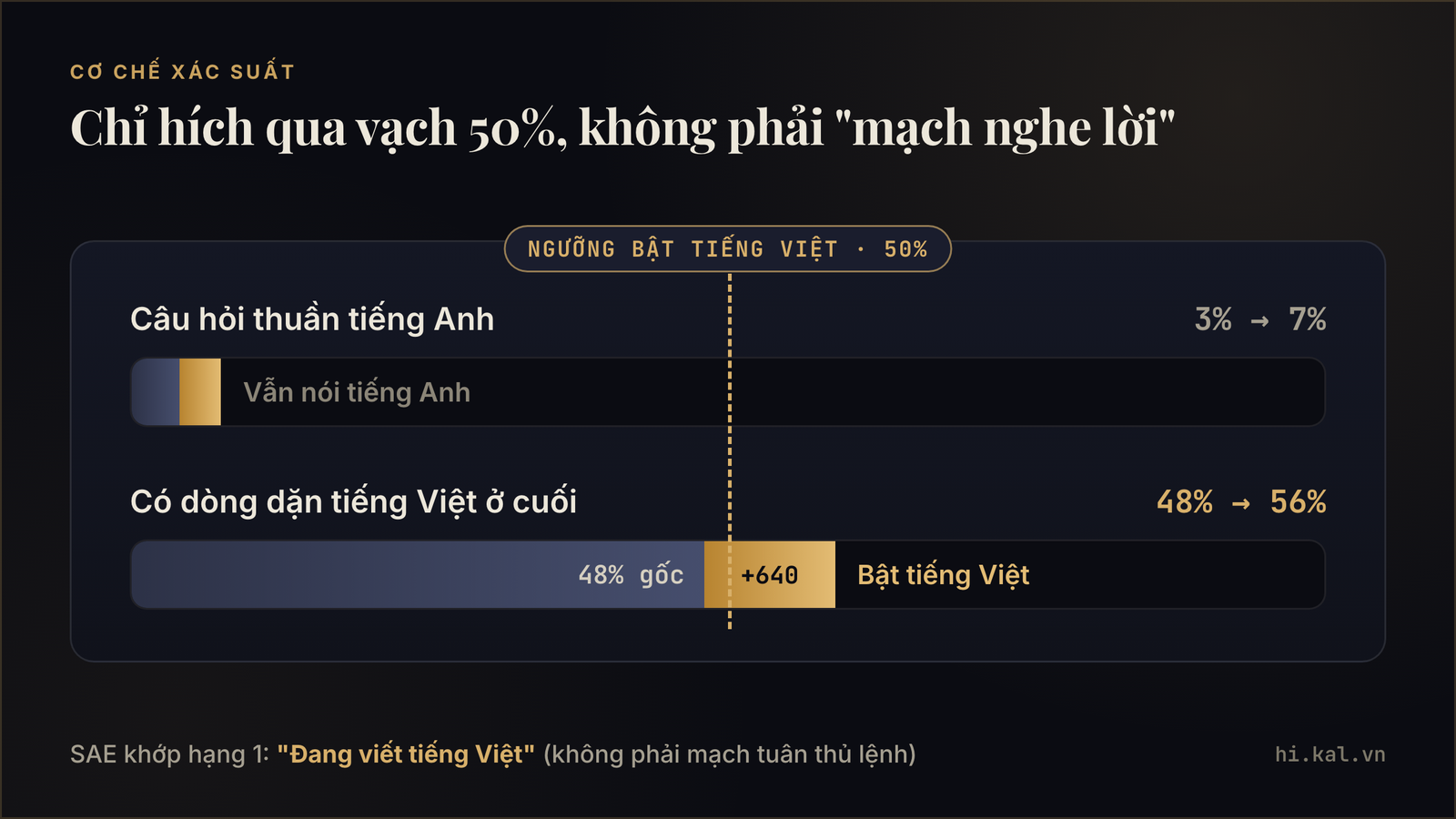
In reality, we did not. If you inspect that exact steering vector through a Sparse Autoencoder (Gemma Scope), the top-activating latent feature is simply "currently generating Vietnamese text" - not a general "obey user constraints" circuit.
A natural follow-up question comes up right away: if we only injected an unconditional Vietnamese bias, why doesn't an ordinary English prompt without any language instruction suddenly hallucinate in Vietnamese?
The answer is pure probability thresholding. On a purely English prompt, the base model's probability mass on English opening tokens dominates overwhelmingly; a modest additive Vietnamese nudge comes nowhere close to flipping argmax or top-p sampling. By contrast, when the prompt ends with "Hãy trả lời bằng tiếng Việt", those Vietnamese tokens already pull a cluster of borderline test cases right up to the edge - sitting around 45% to 49% probability for starting in Vietnamese. Adding a constant vector simply lowers the activation threshold enough to tip roughly twenty borderline prompts across the 50% mark. Once the opening word or transition phrase lands in Vietnamese, autoregressive conditioning carries the rest of the sentence in Vietnamese.
Whenever someone claims to have transferred "instruction-following" across model scales via a static vector, two quick ablation tests expose what is really happening:
- Extract the contrast vector directly inside the small model: Do not benchmark against a random Gaussian vector - adding random noise into deep layers predictably degrades output. Instead, compute the mean activation difference between Vietnamese and English generations directly inside the
270Mmodel itself, without touching any larger teacher model. If that self-extracted vector yields the same seven-point gain, no cross-architecture skill transfer occurred - you simply took a long detour to press a language bias button the tiny model already had. - Test an instruction that opposes the vector's direction: Feed the model a prompt containing Vietnamese text or Vietnamese proper nouns, and instruct it to translate or summarize into English. With a static Vietnamese steering vector baked into a late layer, inertia pulls the model back toward outputting Vietnamese anyway. Whenever the user's instruction runs counter to the hardcoded vector, compliance actually drops below the unedited baseline.
2. "Editing weights with zero training" does not yield a portable model file
Hearing "open the weights file and add a few hundred numbers", most software engineers picture patching a .safetensors or .gguf checkpoint once, saving it, and serving it cleanly through Ollama, llama.cpp, or vLLM.
When I checked the actual layer definitions of modern compact architectures like the Gemma 3 family (270M), two hard architectural barriers block that path. First, every linear projection inside the transformer block disables additive bias terms (bias=False). Second, sitting right at the exit of the MLP block before residual addition is an RMSNorm layer (post_feedforward_layernorm), which also has zero bias parameters.
If you fold your steering vector before RMSNorm, every token gets rescaled by its own root-mean-square norm, warping both magnitude and direction dynamically. And if you want to add a fixed 640-number vector after RMSNorm as done in the experiment, standard .safetensors and .gguf schemas have no parameter slot to store those numbers.
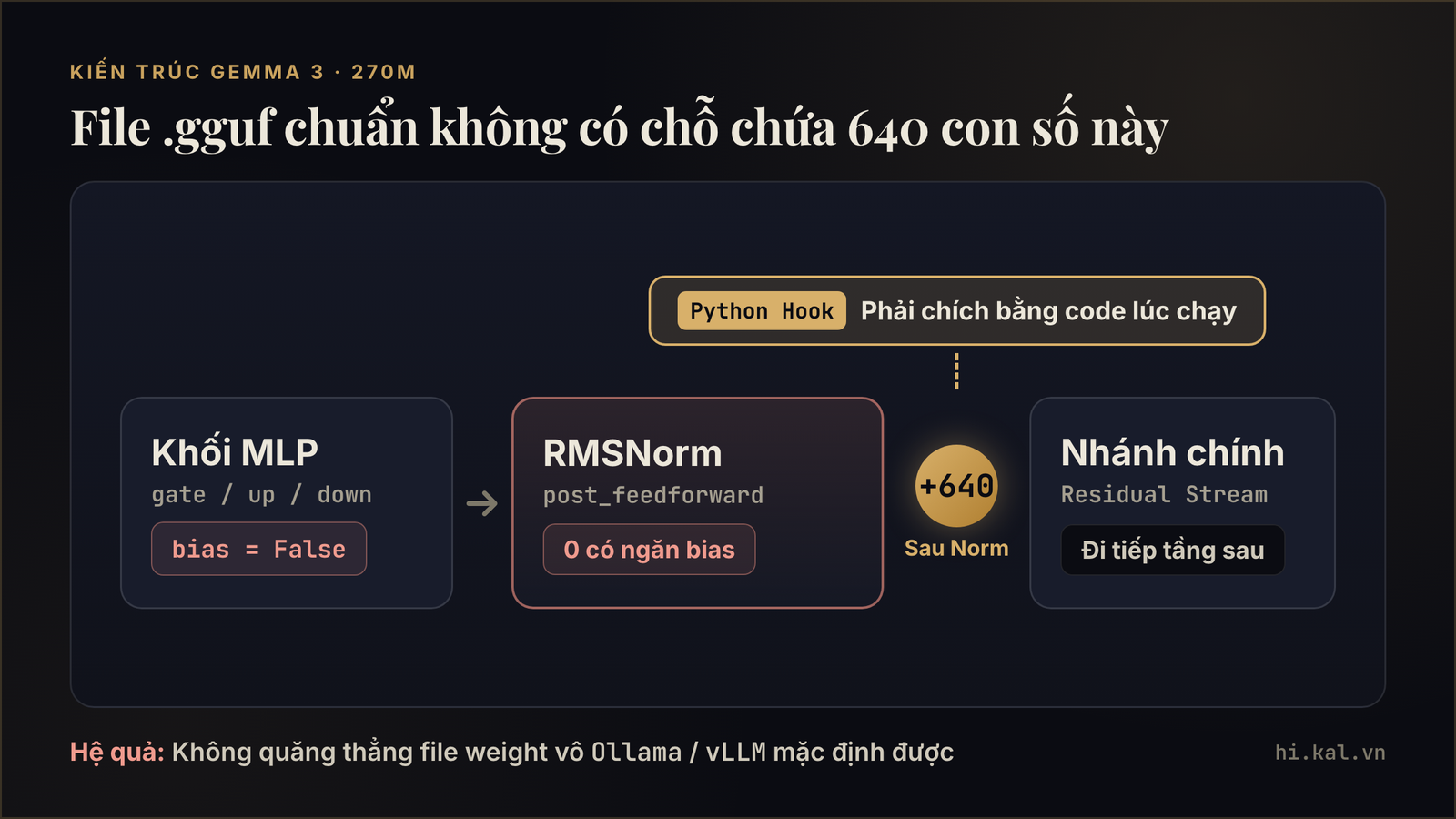
To run it at all, you must attach a runtime Python forward hook or ship custom inference code. Properly named, this is runtime Activation Steering - not a self-contained weight patch you can hand off to standard C++ or GPU serving engines.
Even the "zero training" label deserves honest framing. You do skip gradient backpropagation, yes. Still, projecting from a 2,000+ dimensional teacher space down into a 640-dimensional student space requires running hundreds of paired prompts through both models, collecting activation matrices, solving a regularized linear regression (Ridge), and sweeping steering multipliers on a validation split. That is supervised statistical fitting on data - not opening a binary file and hand-tuning numbers by eye.
3. Self-preference bias when the teacher grades its own steering
Another appealing claim in cross-model steering write-ups is that the small model's Vietnamese prose starts sounding smoother and "closer to the larger model's style". What gave me pause was the evaluation setup: asking that very same larger teacher model to score the outputs.
In AI evaluation (LLM-as-a-Judge), this is classic self-preference bias. You explicitly fit a linear map to pull the student's token distribution toward the teacher's representation habits, and then invite that exact teacher to judge which phrasing feels "more natural". Higher scores from the teacher are virtually baked into the setup.
In my experience, a 1B or 2B parameter model already has shallow Vietnamese vocabulary and shaky stylistic judgment. Handing it the judge's gavel without blind human evaluation or a vastly stronger independent frontier arbiter introduces massive noise - nowhere near solid enough for production sign-off.
4. The gap between 70% and production - and the real cost of LoRA
In an exploratory notebook, nudging accuracy from 60% to 70% makes for an exciting chart. In architecture reviews with business owners and engineering teams, however, I draw a firm line: a working demo is not a self-sustaining production system.
Put 70% into a live business workflow and it means 3 out of every 10 requests ignore your instruction. Even inside the 70% counted as "Vietnamese", tiny models frequently start a sentence in English before awkwardly swerving into Vietnamese mid-clause, or invent misspelled English words mid-sentence because a 270M parameter budget lacks domain vocabulary. Nudging late-layer logits shifts language selection - it adds zero new factual or lexical capacity.
If this exact problem landed on my desk for a production system, I would pick one of two far cleaner paths:
- Fix the interface at the system layer: Asking a
270Mmodel an English question with an abrupt Vietnamese instruction tacked onto the end makes the job artificially hard. Aligning the system prompt language, adding a single concise 1-shot example, or using assistant prefill (seeding the first two Vietnamese tokens of the assistant turn) takes zero weight modifications and routinely pushes language compliance past90%. - Train a lightweight conditional LoRA: Many engineers flinch at "fine-tuning" because they picture renting expensive multi-GPU clusters for hours. That intuition comes from
70Bmodels. On a tiny270Mmodel, running QLoRA or LoRA over 1,000 to 2,000 bilingual instruction pairs on a single consumer16GB VRAMGPU takes 5 to 10 minutes.
Where LoRA decisively beats a static steering vector is input-conditional activation. A LoRA adapter learns when to fire based on the prompt context, pushing compliance into the 98% to 99% range while patching missing phrasing. Best of all, once merged into the base weights, it exports to a 100% standard .gguf file that runs natively on Ollama, llama.cpp, or mobile runtimes with zero custom hooks.
5. Silent breakage where Agents need strict structure most
Hard-wiring a constant vector into a late residual layer applies that shift to every single token the model generates, regardless of the task. If you only sanity-check side effects by generating casual English small talk, everything looks "almost unchanged".
In the Agentic AI pipelines I build, nobody deploys a 270M model to write casual essays. Small models live inside tight operational loops that demand strict structural discipline: emitting valid JSON for tool calling, extracting schema fields, classifying ticket states, or following multi-step state transitions.
Think of a car with properly aligned front wheels where someone welds a permanent shim onto the tie rod so it turns right slightly easier. Right-hand bends feel effortless, right up until you drive fast down a straight highway or reverse into a tight parking bay. Because sub-billion-parameter models already walk a tightrope when maintaining long-range syntax, skewing token probabilities at every step - enough to drop a single comma or closing brace in JSON - halts the entire downstream automation pipeline. Until structured-output benchmarks (JSON schema validity, tool-call AST accuracy, code generation) pass unscathed, static residual shims stay out of production.

Where does representation steering genuinely shine?
Pointing out these five engineering traps does not diminish the value of representation engineering. Every tool in an AI engineer's kit has a job where it excels - problems only start when a diagnostic scalpel gets marketed as a structural beam.
Freed from the unrealistic burden of "replacing fine-tuning for tiny models", these techniques earn their keep in three practical spots. First, as a 5-minute pre-training diagnostic: probing activations tells me quickly whether a small model "already knows the skill and only needs a light data nudge" or "genuinely lacks the underlying representation" (saving wasted fine-tuning cycles when a larger base model is required). Second, when weight-space edits use orthogonal rank-one projections folded directly into existing matrices (such as Abliteration to tame over-refusal, or editing a single language-token row in a speech model's lm_head), standard checkpoint formats remain 100% intact without runtime hooks. Third, keeping activation steering honest as a dynamic, per-request runtime hook lets you dial behaviors up, down, or off on demand.
I have deep respect for builders who crack open model internals down to individual tensors and publish their failed hypotheses alongside their wins. In an industry flooded with hype that treats AI like magic, grounded write-ups about model limits make all of us sharper practitioners.
Crossing from the lab bench into enterprise production simply calls for an old engineering rule: a linear activation nudge can tilt surface habits in narrow settings, but it never substitutes for clean data, conditional training, and resilient system architecture.
Clever tricks build memorable afternoon demos. Disciplined systems are what keep real work running accurately ten thousand times a day.