Shadow AI and Vietnam's 2026 AI Law: The Governance Gap Between Blanket Bans and Personal Phones
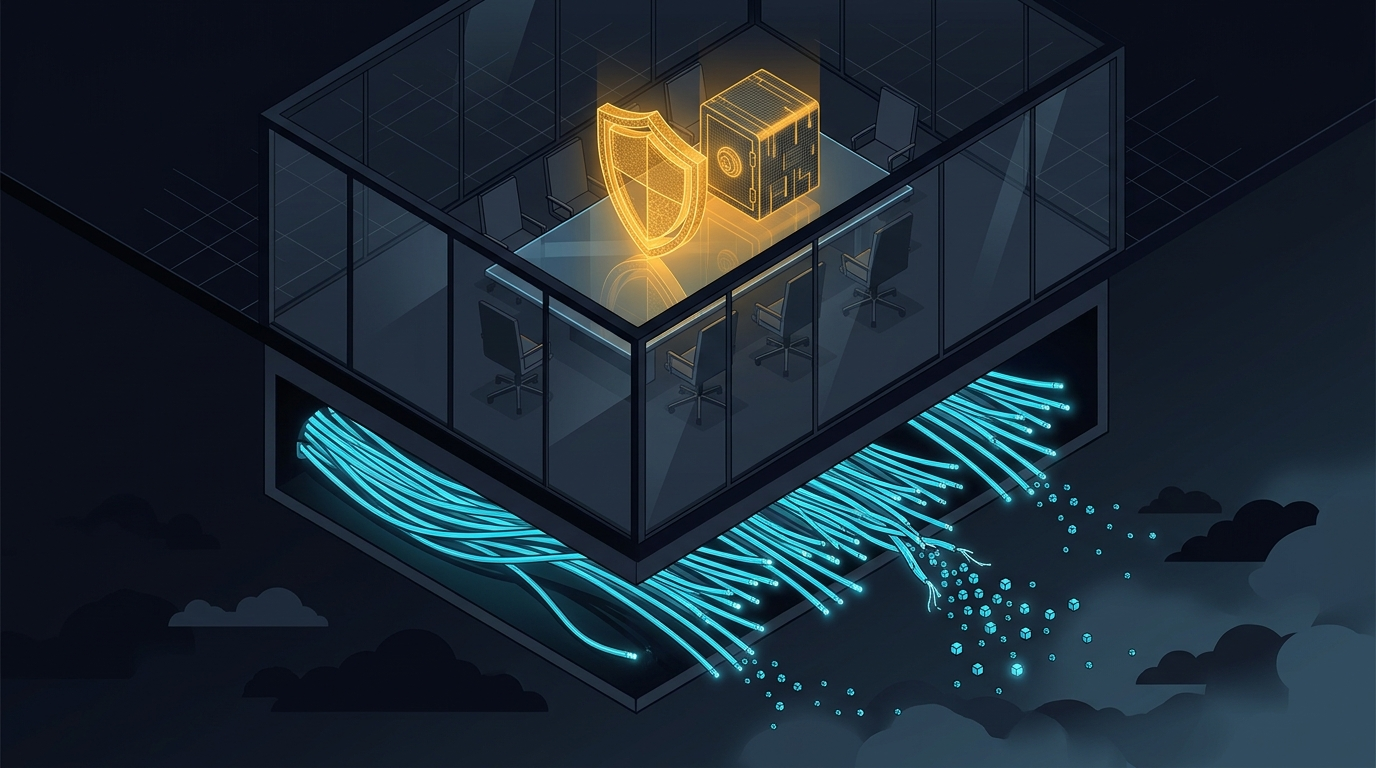
In working sessions with executive boards since early 2026, there is one scene I encounter almost every week. At the head of the conference table, the CIO or General Counsel proudly pulls up an internal policy stamped last year: employees are strictly forbidden from uploading contracts, payroll sheets, or customer records to public artificial intelligence tools. To make doubly sure, the network team has blocked seven or eight popular AI domains right at the office firewall.
Step into the break area for fifteen minutes and talk candidly with the sales managers, HR recruiters, or management accountants, however, and a completely different picture emerges. When an eighty-page tender package needs a pricing response before 5:00 PM, nobody sits around typing summaries by hand out of respect for the office firewall. They pull their personal smartphone out of their pocket, switch off corporate Wi-Fi, turn on personal 4G, snap photos or forward spreadsheets over a chat app, and drop the files straight into a free AI account logged in with their personal email.
Security practitioners call this Shadow AI (unsanctioned AI adoption operating outside organizational visibility and control). Before 2026, many Vietnamese executives shrugged it off as harmless corner-cutting that helped staff hit deadlines faster. Put that underground habit next to two major laws that took effect across Vietnam in the first quarter of 2026, however, and that comfortable gray zone has slammed shut.
A memo banning AI does not stop corporate data from leaving the building. It only blinds leadership, turning a manageable workflow risk on an admin dashboard into an invisible leak underneath the desk.
1. The telemetry beneath the desk: Nearly 40% of corporate data entering AI is now sensitive
If you assume employees pasting internal records into personal AI accounts are rare outliers, endpoint data-movement telemetry tells a sobering story.
In early February 2026, Cyberhaven Labs published its 2026 AI Adoption & Risk Report, analyzing billions of real-world data movements across hundreds of thousands of employees at 222 enterprises spanning web-based GenAI apps, desktop AI applications, and autonomous AI agents. The sharpest warning in the dataset is not raw adoption speed, but the sensitivity of what workers feed into prompts every day.
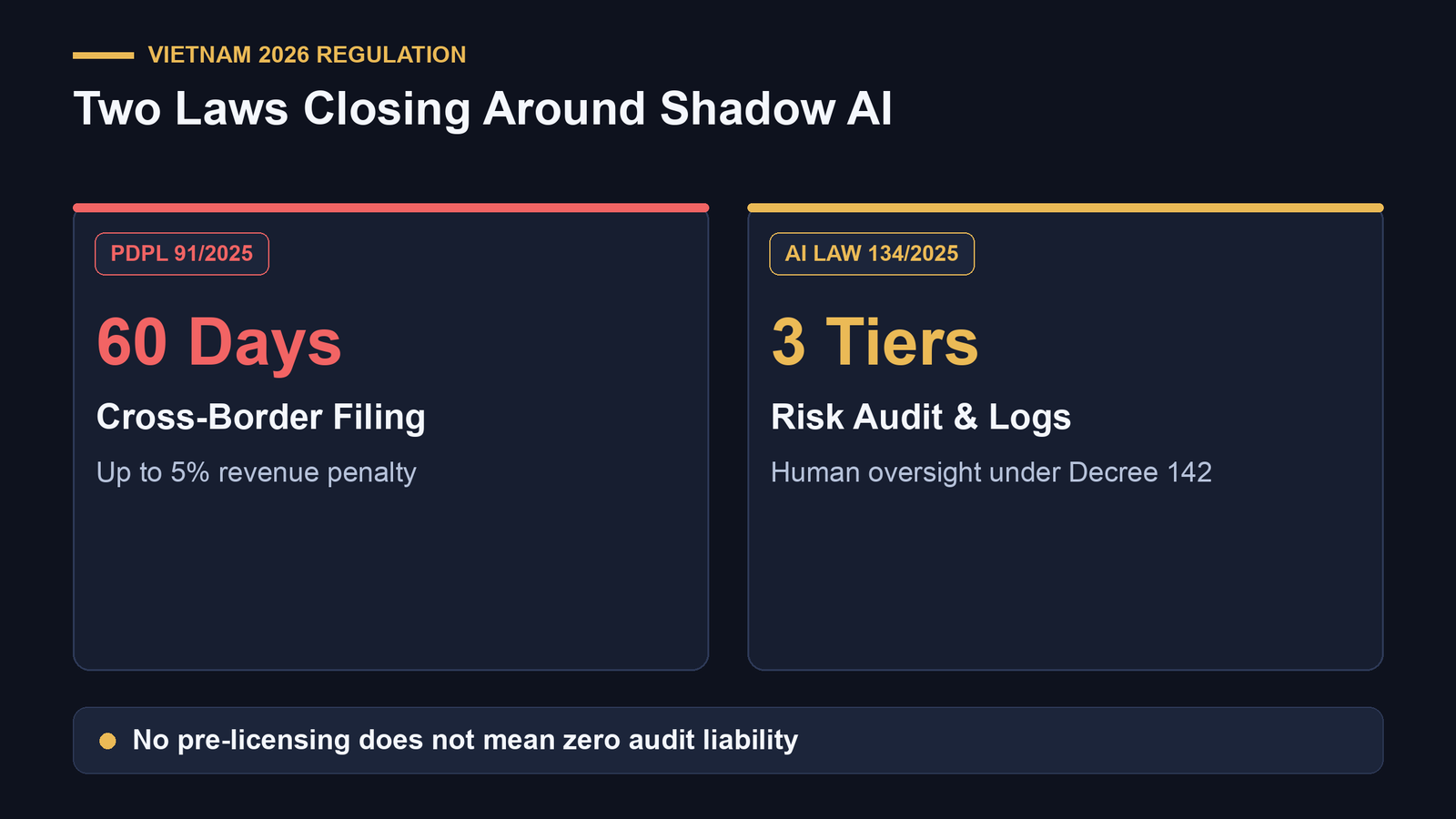
Back in 2023, only 10.7% of corporate data placed into AI tools qualified as sensitive (proprietary source code, customer records, financial statements, HR files, internal pricing). That share jumped to 27.4% in 2024, reached 34.8% in 2025, and climbed to 39.7% in the 2026 report - nearly quadrupling in three years. Workplace AI is no longer used just to polish polite greeting emails; it sits squarely inside core operational workflows.
Right beside that 39.7% figure sits a massive identity blind spot. Cyberhaven found that a huge share of workplace AI traffic runs through personal accounts rather than enterprise-provisioned tenants: 32.3% on the most widely used chat platform, 24.9% on cloud productivity suites, and surging to 58.2% and 60.9% on specialized reasoning, writing, and research platforms. Taken together, at least one out of every three employees using AI for company tasks is logged in through a private consumer account.
Personal accounts bypass every safeguard an IT department pays for: no Single Sign-On (SSO), no centralized audit logs, no enterprise retention rules, and in many consumer tiers, default opt-in settings that allow foreign vendors to retain prompts for model training.
Worse still, 2026 marks what researchers call the "second wave" of workplace AI. Even as browser-based chat usage begins to plateau, mid-level engineers and operations staff (who adopt AI at 3.5x the rate of managers) are rapidly installing AI coding assistants, AI-enabled browsers, and local agents directly on endpoints. Unlike a browser tab that waits for copy-paste, these tools read entire project folders, configuration files, and local mail archives directly off the disk.
2. Vietnam's 2026 regulatory pincer: No pre-licensing does not mean zero audit liability
Whenever I raise the legal exposure of Shadow AI, the most common reaction from mid-market and large enterprise founders is a wave of the hand: "We run retail, manufacturing, or B2B services - we don't train foundation models to sell. Vietnam's new AI Law uses post-market oversight, and we're just end users, so what is there to worry about?"
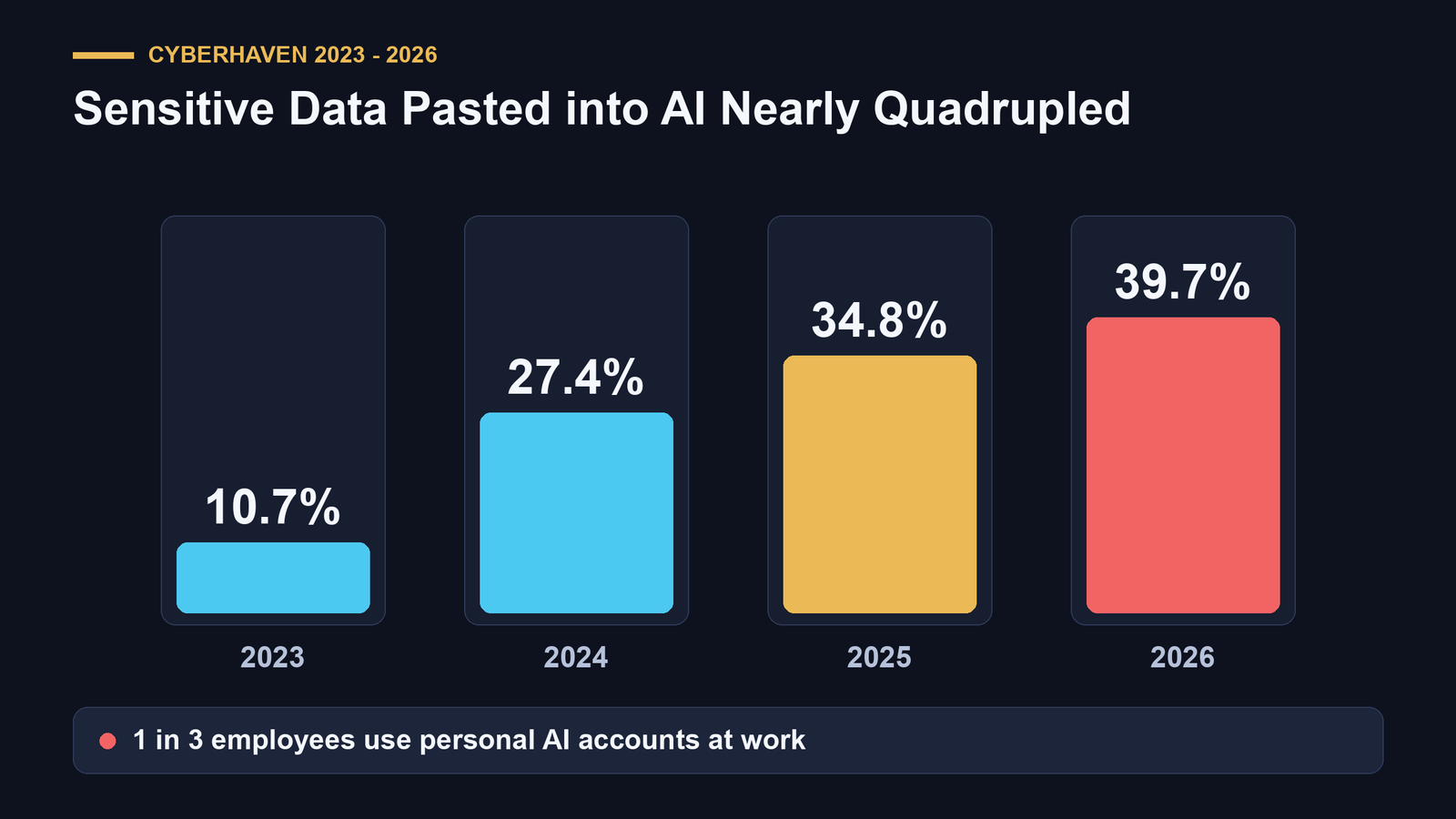
That surface reading misses the tight interlocking pincer formed by two statutes that entered into force in Vietnam in early 2026: the Personal Data Protection Law No. 91/2025/QH15 (PDPL, effective 01/01/2026) and the Law on Artificial Intelligence No. 134/2025/QH15 (passed 10/12/2025, effective 01/03/2026, detailed by Decree 142/2026/NĐ-CP of 30/04/2026 and the high-risk AI list under Decision 33/2026/QĐ-TTg).
Let us examine how both jaws of that pincer close directly around unmanaged Shadow AI inside an enterprise.
Jaw 1: Cross-border personal data transfers triggered by a single paste
Consider the most routine task in HR or customer operations. A recruiter gathers two hundred candidate resumes containing full names, birth dates, phone numbers, home addresses, and prior salaries - or a support lead exports a customer complaint log - and uploads the spreadsheet to a foreign-hosted consumer AI tool to rank applicants or summarize sentiment.
Under Vietnam's Personal Data Protection Law 91/2025/QH15, the moment that file leaves the device to be processed on automated infrastructure outside Vietnamese territory, a cross-border personal data transfer (Article 20) and AI personal-data processing activity (Article 30) has legally occurred.
Under Article 20(2), any organization transferring personal data across borders must compile a formal Cross-Border Personal Data Transfer Impact Assessment Dossier and submit an original copy to the specialized personal data protection authority within 60 days from the first day of transfer. That dossier is subject to periodic inspection (up to once per year) or unannounced audit whenever a leak or complaint arises. Most sobering is the administrative penalty ceiling under Article 8(4): violations of cross-border transfer rules carry a maximum fine of up to 5% of the organization's prior-year revenue (or up to VND 3 billion under Article 8(5) where prior revenue does not apply or yields a lower cap).
Here is where Shadow AI turns toxic. When your legal team prepares its official impact assessment filing, they list sanctioned enterprise software under contract: CRM, ERP, payroll cloud, and official cloud storage. No compliance officer on earth can declare seventeen consumer AI apps that department staff signed up for on personal credit cards. When a data leak or customer dispute hits, pleading that "an employee used their own 4G phone to hit company KPIs" does not absolve the corporate entity of its statutory duty as a Personal Data Controller to maintain technical and organizational safeguards.
Jaw 2: "Deployer" obligations and risk-tier escalation under AI Law 134/2025/QH15
The second jaw sits inside Vietnam's Law on Artificial Intelligence 134/2025/QH15 and Decree 142/2026/NĐ-CP. Vietnamese lawmakers deliberately chose an innovation-friendly, risk-based structure: classifying AI systems into three risk tiers (low, medium, and high under Article 9) rather than requiring pre-licensing for ordinary business tools.
However, Article 3 assigns explicit legal duties by role. Alongside Developers and Providers, every company that puts AI systems into operational business use acts legally as a Deployer. That role carries three concrete post-audit obligations that Shadow AI quietly sabotages:
- Risk-tier escalation when changing intended use (Article 10(2)): A general-purpose chat model may be classified as low or medium risk by its provider when used for drafting memos. Yet if an internal team wires that same model into spreadsheets to score job applicants, evaluate creditworthiness, classify students in education, or assist clinical triage in healthcare (essential sectors governed strictly under Articles 6, 13, 14 and Decision
33/2026/QĐ-TTg), modifying its operational context triggers higher-risk obligations. Those include mandatory human oversight and intervention capability and maintaining technical activity logs for post-market inspection. - Transparency and labeling duties (Article 11 and Decree
142/2026/NĐ-CPArticles 16 - 18): When marketing or support teams use unsanctioned tools to generate synthetic audio, likenesses, or automated customer-facing interactions without clear disclosure labels, liability lands directly on the deploying enterprise. - Serious incident reporting (Article 12 and Decree
142/2026/NĐ-CPArticle 19): When an AI workflow causes material harm or a serious incident, deployers must record, report via the national single-window AI portal, and cooperate in remediation. If your company's prompts sit scattered across fifty unmanaged personal accounts, you have zero audit logs to produce when inspectors ask what happened.
To be strictly accurate on the regulatory timeline: as of Q4 2026, the standalone decree detailing AI-specific administrative fine brackets under Article 29(5) of the AI Law is still being finalized. Yet civil damages liability under Article 29, regulatory authority to suspend non-compliant deployments, and the 5% revenue penalty under PDPL 91/2025/QH15 are already fully enforceable today.
3. The governance paradox: Blanket bans only widen your blind spot
Confronted with both risks, the knee-jerk instinct of many boards is to tighten the screws further: threaten disciplinary termination, block every generative domain on office Wi-Fi, and write stricter compliance pledges.
Field experience across enterprise AI rollouts shows that this "build a dam across the river" approach fails nine times out of ten because it fights basic workplace economics.
When executives raise output targets by fifty percent, demand market analyses in hours instead of days, and simultaneously lock official tool procurement behind a two-month sign-off queue, top performers will protect their productivity first. Block AI on office desktops, and they run it on home laptops at night. Block reputable enterprise vendors, and they drift toward obscure wrapper sites that haven't made the firewall blocklist yet - where data harvesting risks are ten times worse.
Shadow AI is rarely an employee ethics problem. It is an architectural warning flare signaling that official company tooling has fallen dangerously behind real work pressure. The only durable way to shut down unsafe jungle footpaths is to pave an official highway that is faster, easier to use, and lined with guardrails on both sides.
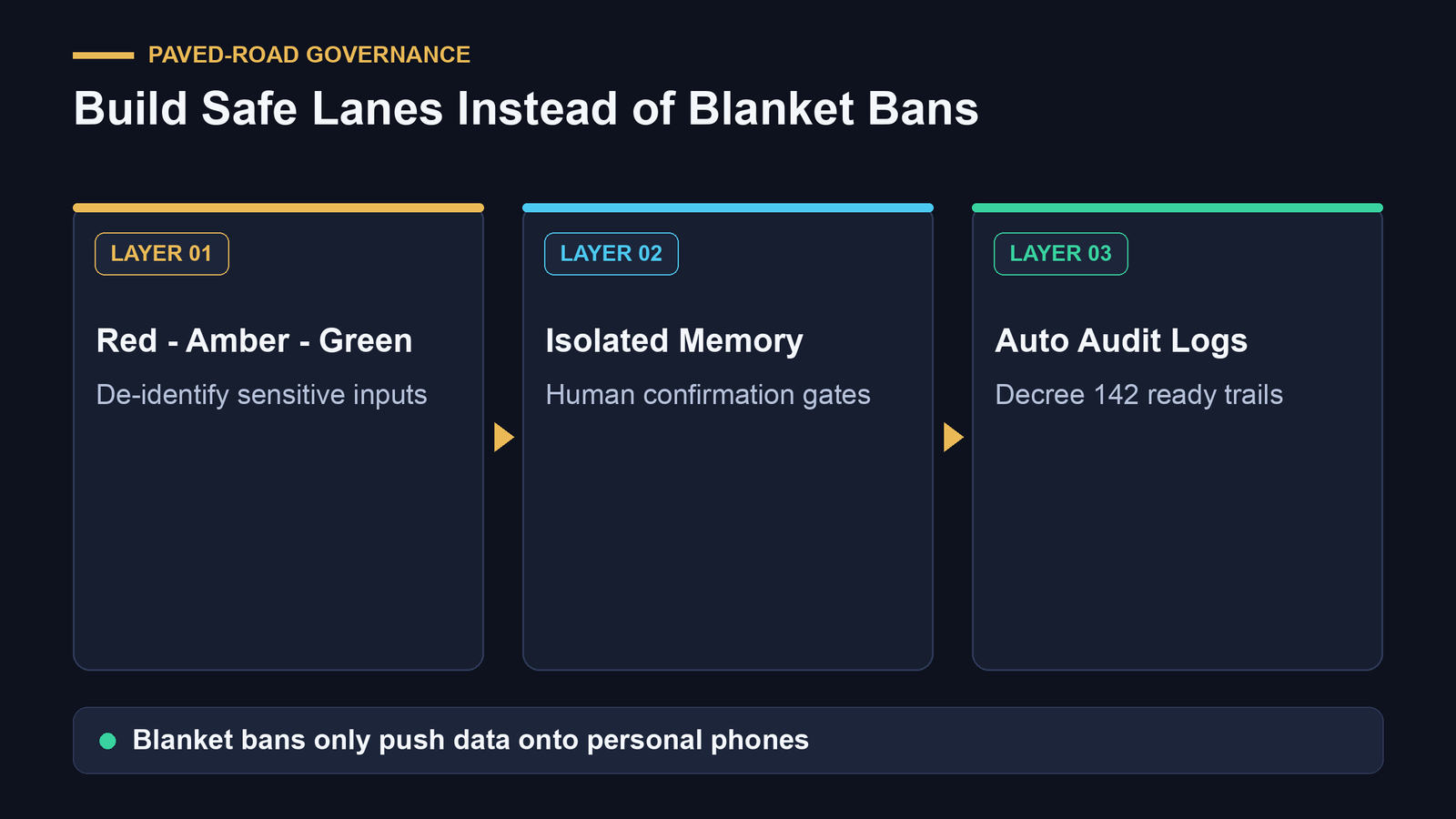
4. A 3-layer "Paved-Road" architecture to tame Shadow AI without slowing teams down
Instead of drafting an eighty-page governance binder that nobody reads past page three, executive teams can neutralize Shadow AI in 2026 with three practical, auditable layers.
Layer 1: Red - Amber - Green data classification and source de-identification
Article 2(1) of Vietnam's Personal Data Protection Law 91/2025/QH15 contains a pivotal technical clause: "Personal data after de-identification is no longer personal data."
Rather than issuing vague bans against "confidential uploads," give every department a crystal-clear traffic-light rule right at the point of work:
- Red Zone (Never leaves isolated infrastructure): Core trade secrets, production credentials, raw sensitive personal data (medical records, biometrics, named financial statements), unannounced M&A terms.
- Amber Zone (Sanctioned enterprise AI tenant only, stripped of identifiers first): Contract templates for clause review, anonymized sales tables (
Customer_01,Vendor_B), internal meeting notes, standard application code. Stripping real names, national ID numbers, phone numbers, and direct identifiers before prompting drops cross-border personal data exposure close to zero. - Green Zone (Open acceleration): Public market research, marketing copy outlines, translating public documents, summarizing published regulations.
Layer 2: Provisioned workspaces with isolated memory and human confirmation gates
To get employees off consumer accounts, give them an official workspace that noticeably outperforms free tools while enforcing three hard architectural guarantees:
- Contractual zero-training retention: Commercial enterprise agreements that prohibit training on company inputs, giving legal teams clean ground to file a single organization-wide cross-border transfer assessment within the statutory
60-daywindow. - Project-level memory and workspace isolation: Marketing prompts should never bleed into procurement pricing context. When we built our executive assistant platform KaleraPA and our MCP long-term memory server Munin, strict per-project isolation and optional end-to-end encryption for sensitive memory vaults were non-negotiable foundations from day one.
- Human confirmation cards before external blast-radius actions: Satisfying Article 14's human-oversight mandate means letting Agents freely read, summarize, and draft inside the workspace, while enforcing an explicit human confirmation gate before any action that sends an email, publishes a post, alters production records, or deletes files.
Layer 3: Automated audit trails and role-specific operational training
Finally, every workflow running along the paved road should automatically log lightweight operational metadata: which authenticated user invoked a task, inside which project scope, at what timestamp, and who approved an outbound action. When regulators conduct an annual PDPL check or a post-market review under Decree 142/2026/NĐ-CP, you export a clean audit trail in minutes rather than guessing.
Pair that technical lane with two hours of hands-on, role-specific training for HR, finance, sales, and engineering. Once staff see concretely why pasting a named payroll sheet over personal 4G exposes the company to revenue-scale fines - and already have a faster, company-paid assistant sitting on their desktop - Shadow AI evaporates without a single threat.
Closing note for your next board meeting
Late 2026 is far past the point of debating whether to "allow" AI inside your company. Nearly 40% of workplace AI inputs already carry sensitive business data, with or without your blessing. The only real executive decision left is whether that data keeps flowing through dozens of invisible personal phones outside legal compliance, or moves onto an audited highway where leadership holds the steering wheel.
If your leadership team wants to audit internal Shadow AI exposure, align data workflows with Vietnam's AI Law 134/2025/QH15 and PDPL 91/2025/QH15, or roll out an isolated, confirmation-gated workspace like KaleraPA, our team at Kalera Academy is always happy to sit down via hi.kal.vn and build a practical governance lane tailored to how your people actually work.