Why AI Blocks You From Testing Your Own Server While Hackers Slip Through: Inside Google's GTIG Report and a 4-Agent Blue Team
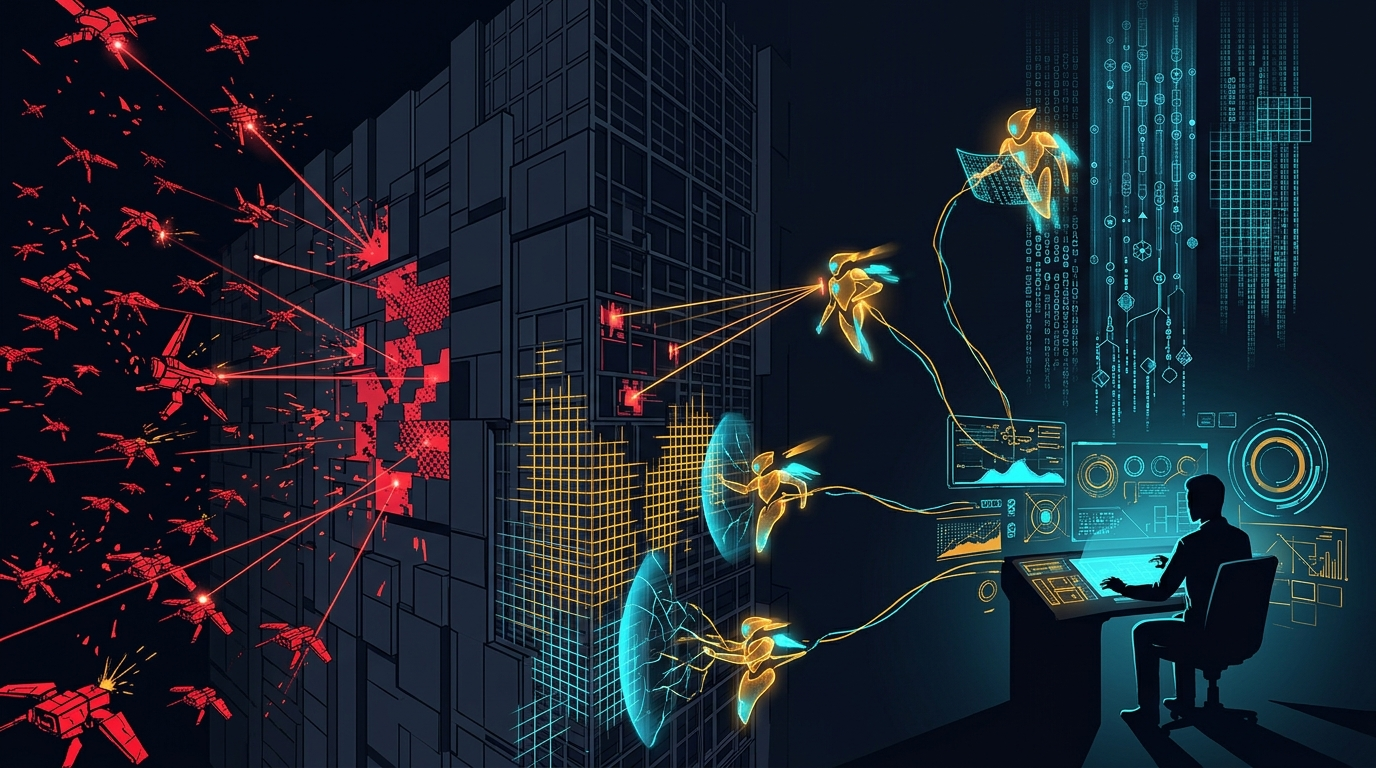
Ever since mid-November 2026, right after Google Threat Intelligence Group (GTIG) and Mandiant published their quarterly report Agentic Threat Activity Crosses a Significant Threshold, my inbox and coffee chats with founders have revolved around the exact same question.
The person asking is usually a SaaS founder or engineering lead running their own production stack. They describe the situation with equal parts frustration and disbelief: "Look, I legally own that server. I pasted our endpoint config into an AI assistant to check whether our own API had a privilege-escalation or remote-code-execution flaw, and the safety guardrails lectured me on policy and shut the chat down cold. Meanwhile, Google says threat actors are running autonomous AI frameworks to find bugs and exploit live targets with no human in the loop. So what dark-web model are hackers actually using?"
It is a fair question, and it hits a raw nerve for builders playing by the rules: the homeowner gets handcuffed on the front porch while intruders seem to walk right through the gate.
Yet when you read the technical details of GTIG's November 16, 2026 report alongside the latest code-security telemetry from Veracode - and compare both against a live defensive engagement I ran on our own infrastructure last week - a very different reality emerges. Attackers do not possess some mythical underground frontier model. Even more importantly, if you understand software architecture and cybersecurity fundamentals, defending systems in the Agentic AI era has actually become calmer and far more manageable than it ever was before AI.
There is no secret "dark model" tilting the board toward attackers. Survival comes down to whether a builder has enough security intuition to know which features breed vulnerabilities before an automated patch-diffing bot knocks on the door.
1. Decoding Google's GTIG report: What models hackers actually use, and why public chat blocks the rightful owner
First, let us clear up why a commercial chat interface blocks you from probing your own stack. When you type "Generate an exploit payload to test remote code execution on my company server X", the model does not refuse out of malice. It refuses because of a hard architectural limitation: cloud AI chat interfaces are completely blind to asset ownership.
From the model provider's side of the wire, a conscientious CTO stress-testing their own staging cluster and an external intruder probing a bank's API look semantically identical. Standard chat windows have no cryptographic domain-ownership handshake (DNS verification) and no signed penetration-testing scope letter attached to the prompt. Because the model cannot verify the words "my server", commercial providers enforce the lowest common safety denominator and block direct exploit-generation requests across the board.
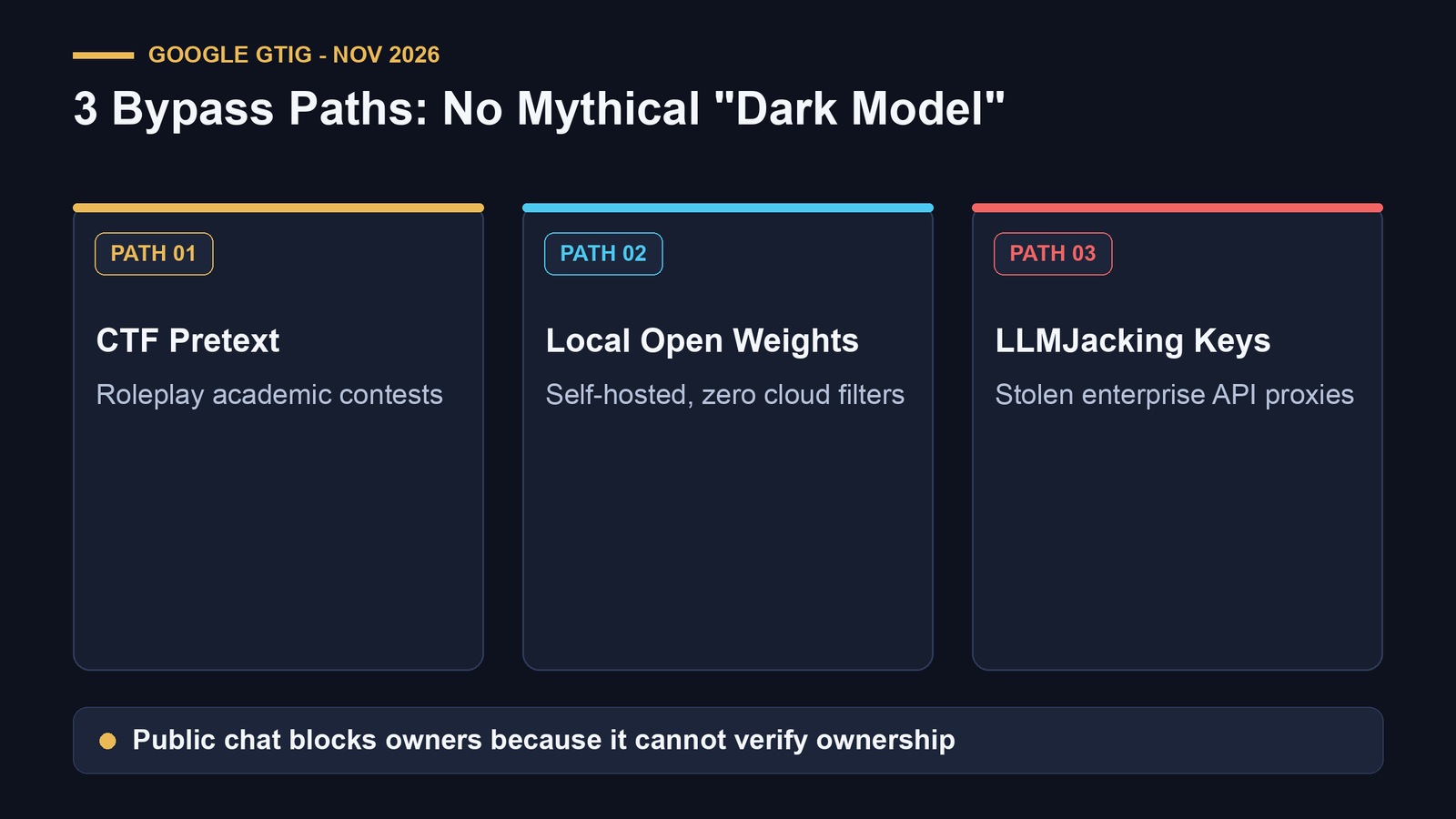
How, then, did threat actors in Google GTIG's report get around those guardrails? Not with magic models, but through three pragmatic bypass paths often wired together:
- Social-engineered pretexting (
CTFroleplay): Honest engineers state plainly that they are testing a live production server - and trigger refusal filters immediately. Threat actors wrap the exact same technical problem inside benign academic framing: solving aCapture The Flag (CTF)competition challenge, debugging a university lab exercise, or analyzing how a patch works.GTIGdocumented adversaries whose direct exploitation prompts were blocked, who then reframed the request as aCTFcontest problem, got actionable technical assistance, and reused that exact framing template successfully for weeks. - Pairing commercial frontier models with unfiltered local open-weight models: This is the centerpiece of
GTIG'sNovember 16, 2026disclosure. Examining an exposed staging server operated by Russian-speaking actors targeting French media and education sites, researchers recovered a multi-agent framework dubbedexploit_agent(alongside open-source offensive frameworks such asCAIRN,ARTEX,PentAGI, andHexStrike AI). Rather than relying on a single vendor,exploit_agentintegrates with both commercial frontier models and locally hosted open-weight models. High-level code comprehension and patch comparison can run anywhere; whenever payload generation hits a cloud refusal filter, the pipeline routes the step to a self-hosted open-weight model with zero cloud safety rails. - Stolen enterprise API keys (
LLMJacking): In a companion analysis published onNovember 2, 2026,GTIGdetailed underground proxy markets such asLLM Mixerthat aggregate compromised enterprise cloud credentials and resell high-tier model access. Attackers burn the victim organization's own API quota while rotating across stolen enterprise accounts to evade abuse detection.
Once you understand those three paths, the takeaway for legitimate defenders is straightforward: stop arguing with consumer chat boxes, and run authorized security testing through dedicated, scope-authenticated offensive security tooling instead.
2. The patch-to-exploit grace period has collapsed from weeks to under an hour
Jailbreaks and local models have been around for a while. Why did Google GTIG declare in November 2026 that agentic threat activity had just "crossed a significant threshold"?
Only ten weeks earlier, in its September 2026 tracker, GTIG noted it had not yet observed fully autonomous exploitation pipelines operating against targets in the wild. exploit_agent crossed that line: for the first time, researchers caught a multi-agent system automating the entire chain - vulnerability discovery, exploit authoring, and live execution - with no human steering each step.
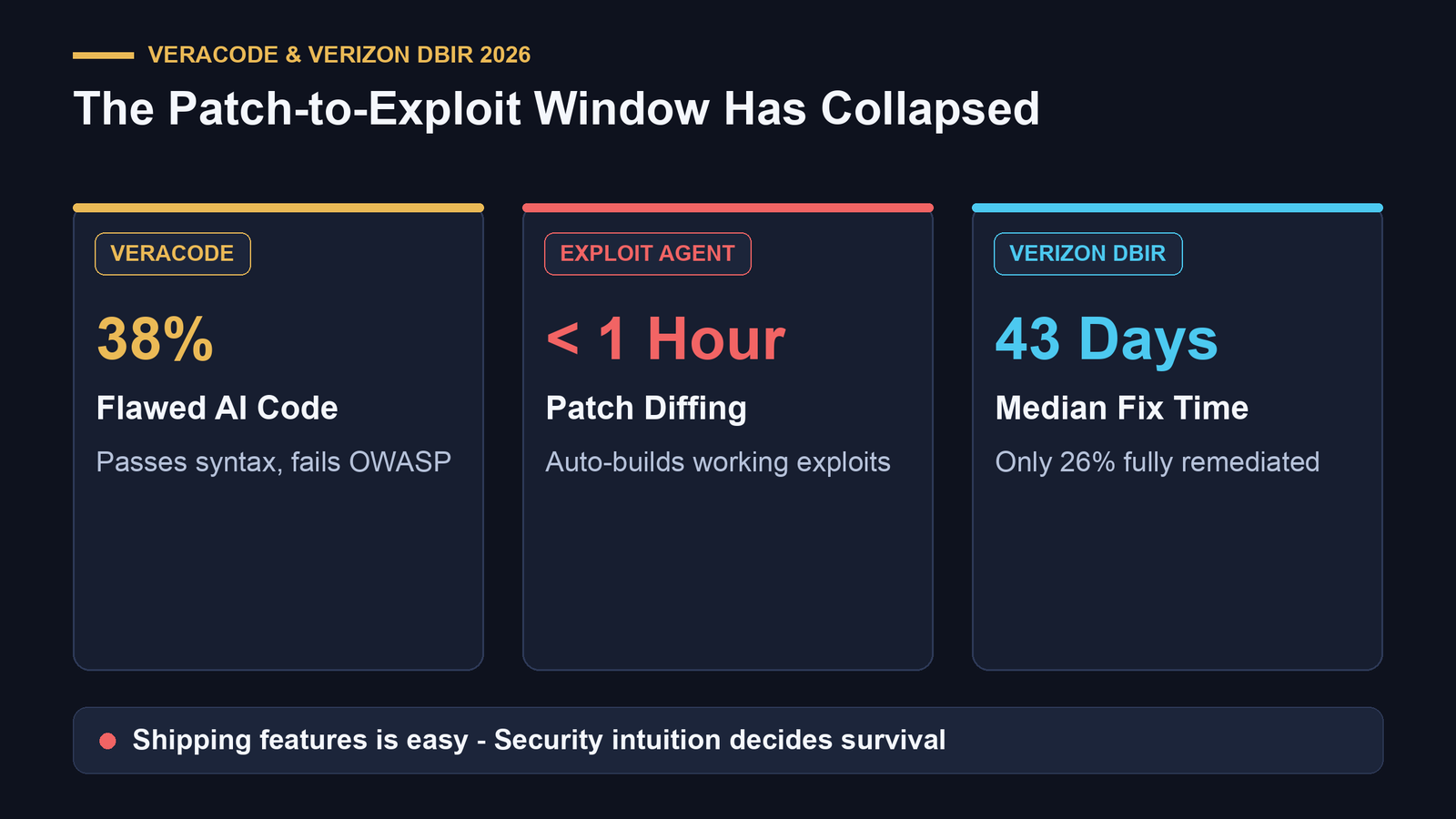
Crucially, exploit_agent was not inventing exotic zero-days from thin air. Its core engine ran continuous differential patch analysis (patch diffing) against popular web software and plugins. The moment an open-source vendor published a security update, the framework compared the unpatched and patched code side by side, pinpointed the exact authorization check that changed (such as a capability check inside a WordPress REST endpoint), drafted a working exploit, and fired it automatically against unpatched servers.
Place that wild discovery beside three independent 2026 measurements, and the operational squeeze becomes unmistakable:
- Weaponizing a public patch now takes less than an hour: Controlled empirical testing published in
June 2026across18Firefoxengine source patches showed a frontier model producing crash triggers for14bugs within roughly three hours and crafting its first working exploit in just under1hour -18days before the patched browser build even shipped to end users. OnNovember 13, 2026,Google Project Zeroformally eliminated its post-patch "soak time" grace period, stating plainly that buffer windows are no longer meaningful when attackers can reconstruct bug details from a patch almost immediately. 38%of AI-generated code still ships with security flaws: According toVeracode's Fall 2026 GenAI Code Security update (October 29, 2026, testing18leading models acrossPython,JavaScript,Java, andC#), even though generated code achieves99 - 100%syntax validity, roughly38%of AI-generated code samples still failOWASPsecurity checks. Even the top two models tied at the very top of the global leaderboard topped out at a73%pass rate (leaving over a quarter of generated tasks vulnerable), while context-heavy flaws like log injection stagnated near a12%pass rate. Meanwhile,82%of organizations already carry unresolved security debt older than a year.- Traditional enterprise patching is actually getting slower: The 2026 Verizon Data Breach Investigations Report (DBIR) found vulnerability exploitation to be the top initial breach vector at
31%, yet median organizational patch time slipped backward from32days to43 days, with organizations fully remediating only26%of flaws inCISA's Known Exploited Vulnerabilities catalog.
One side turns a public commit into a live automated exploit in under sixty minutes; the other side ships 38% vulnerable AI code and takes 43 days of ticket queues to deploy a patch. That gap is where naive software teams get wiped out.
3. Building a working product is easy now - knowing which features breed vulnerabilities is the real moat
Faced with those numbers, engineering leaders often swing to one of two extremes: panicking and trying to ban AI coding tools, or closing their eyes and shipping blindly to beat competitors to market.
My view as a builder in late 2026 is much simpler: with modern AI assistance, turning an idea into a working software product is no longer the hard part. A sharp founder or small team can assemble functional workflows in days that once took a quarter. What separates a durable business from a headline breach comes down to two things: understanding what AI is actually doing under the hood and holding real cybersecurity intuition.
Let me be precise about what "knowing what AI is doing" means in practice, because it does not mean a human trying to out-read a machine line by line across ten thousand lines of harmless UI styling.
Security knowledge means looking at a product specification and instantly recognizing which features open an attack surface:
- This feature accepts file paths or URL-encoded route parameters - did the AI stitch raw strings together in a way that invites path traversal or slips past an upstream proxy when an attacker encodes a slash as
%2F? - That feature serves multiple enterprise customers out of one database - does every secondary API route enforce tenant isolation, or did the AI check permissions on the dashboard page while leaving background endpoints wide open to cross-tenant ID swapping?
- Billing relies on asynchronous payment webhooks - does the handler verify cryptographic signatures and replay timestamps, or blindly trust any JSON payload claiming an invoice was paid?
- An internal Agent summarizes inbound emails and external web pages - can untrusted text inside an attachment hijack tool execution if destructive actions aren't locked behind a deterministic human confirmation gate?
When you carry that threat map in your head, AI-generated code volume stops being overwhelming. You let automation fly through the harmless eighty percent of the interface, and concentrate relentless code review, adversarial testing, and hard architectural guardrails on the twenty percent of features where real vulnerabilities live. Builders who cannot recognize danger inside their own feature set will inevitably get overrun; builders who do have never had stronger leverage.
4. Field notes from the Blue Team trench: Why getting probed last week felt surprisingly calm with 4 Agents
That exact security intuition does more than prevent bugs before launch - it completely transforms how it feels when your live infrastructure actually comes under fire.
Last week, our production service cluster absorbed a sustained wave of automated vulnerability reconnaissance sweeping across multiple domains, probing admin paths, API routes, and encoded URL variants.
Anyone who has worked Blue Team incident response in the pre-Agent era knows the visceral stress of a night like that: a dozen terminal windows open at 2:00 AM, grepping hundreds of thousands of raw access-log lines by hand, looking up unfamiliar ASN blocks, and nervously editing live firewall expressions while praying a single typo doesn't lock paying customers out of production.
Last week felt completely different. Honestly, for the first time in my entire career working around cybersecurity, I sat in the Blue Team seat during live probing and felt... remarkably relaxed.
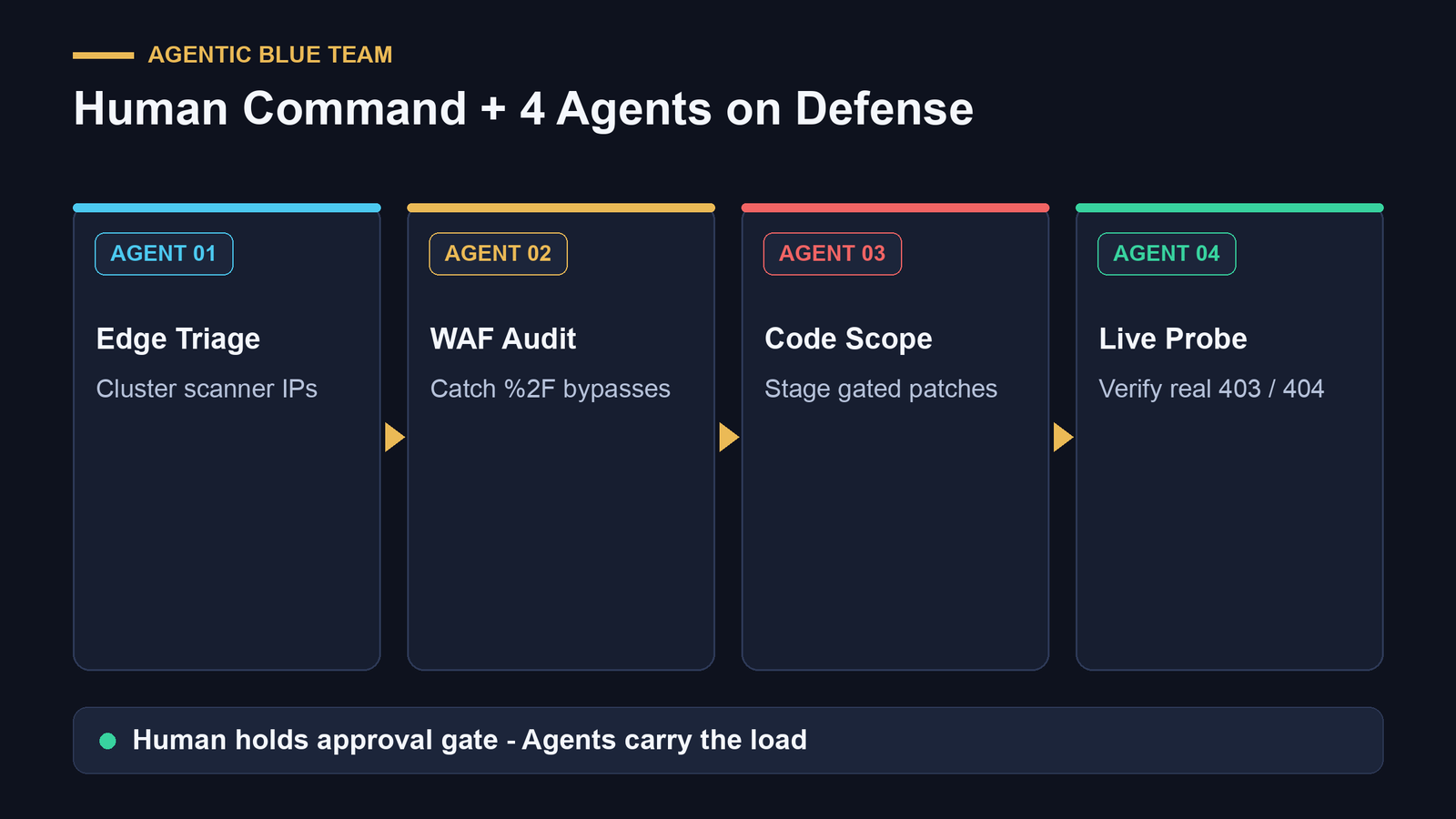
The moment our edge sentinel raised an alert, instead of diving headfirst into raw logs myself, I stepped into the commander's chair and dispatched 4 specialized Agents to work the problem in parallel:
- Agent 01 - Edge log triage and behavioral clustering: Scanned access telemetry across every domain, grouping offending IPs by origin
ASN, request cadence, and path signatures. Within minutes, it cleanly separated malicious external scanner clusters slated for permanent ban rules from a legitimate internal hourly sync job that had tripped a noisy threshold - preventing a painful self-inflicted outage. - Agent 02 - Cross-domain
WAFrule-order auditing: Rather than assuming "admin paths are already protected," I tasked the second Agent with auditing custom firewall rule precedence across every zone. It caught a subtle, high-impact gap before attackers could chain it: on one subdomain pair, standard/adminrequests were blocked as intended, but encoding the slash as%2F(/admin%2Flogin/) matched an upstream cache-bypass skip rule first and returned the underlying login page withHTTP 200. A tired human staring at ten rule tables at midnight easily misses rule-ordering edge cases; an Agent cross-checking every zone caught it cold. - Agent 03 - Scoped code inspection and gated patch staging: Traced how target apps handled unmatched routes, drafted strict
404/403hardening patches plus the exact top-priority%2Fblock rule, and queued everything in a reviewable staging summary. Crucially, no Agent had unilateral authority to mutate live production firewalls on its own. Every infrastructure-touching action paused at an explicit human approval gate for my thirty-second review - the exact confirmation-card discipline we build into KaleraPA, paired with logging structured incident context into our shared Munin memory server so future shifts inherit every lesson automatically. - Agent 04 - Independent live verification probes: Once I approved and deployed the updates, the fourth Agent acted as an external auditor, firing plain routes,
%2F-encoded variants, and mixed-case payloads against every live endpoint to verify firsthand that real network responses came back403and404- zero trust in unverified assumptions.
All four streams ran concurrently. The exhausting, error-prone grunt work - parsing log mountains, checking rule precedence permutations, firing regression probes - was absorbed entirely by the Agent squad. As the human in command, I focused strictly on the two things machines cannot own: knowing where the dangerous seams hide and holding the final approval key.
We sealed every seam without dropping a single legitimate user session, and the coffee on my desk didn't even go cold.
The balance hasn't tilted toward attackers - it has tilted toward people who understand the system
Put Google GTIG's exploit_agent report side by side with that live Blue Team run, and the takeaway is clear-eyed rather than alarmist.
AI is not an offensive superweapon reserved for cybercriminals; it is a ruthless force multiplier. In the hands of builders who blindly ship whatever code an assistant spits out without understanding trust boundaries, AI multiplies vulnerability creation tenfold and leaves the front door unlocked for automated patch-diffing bots. In the hands of someone who understands architecture and recognizes where features breed security risk, AI turns a single calm defender into a coordinated Blue Team squad that works faster and sleeps far better than in the pre-AI era.
How to go from raw idea to live product without falling into the "works in demo, collapses under probing" trap of Vibe Coding deserves its own dedicated deep dive - and I will unpack that exact playbook in an upcoming post here.
In the meantime, if your leadership or engineering team is accelerating product delivery with AI and wants practical training on threat-surface intuition, or wants to deploy confirmation-gated Agent workflows like KaleraPA through Kalera Academy, reach out anytime via hi.kal.vn. Shipping fast gets you into the market; knowing what your AI just built is what keeps you there.